Context
Grocers lose a large share of revenue every year to perishables that are no longer fresh. The loss compounds when a freshness call is made for a whole category or a whole pallet from one supplier, rather than for the package in front of you.
Freshness today is judged in two ways. Qualitative checks — colour, smell — are fast but unreliable. Quantitative methods, like counting colony-forming units, are accurate but live in supplier or quality labs and need a technician. Neither gives a store, a distribution centre or a shopper a direct reading on a specific pack.
The problem
Most package-level freshness sensors sit in the headspace, reading whatever gas happens to collect above the product. That reading drifts with the size of the headspace, temperature swings, humidity, packaging materials and outside air. Some formats, like ground-meat chubs, have no headspace at all.
If the signal lives inside the meat, the sensor has to get inside the meat — without contaminating it or breaking the pack.
That creates a mechanical contradiction. A sensor that pierces cleanly needs a sealed, smooth spike. A sensor that can sample gas needs openings. Opening those holes during insertion would shear the meat and draw contamination into the device.
Patent contribution
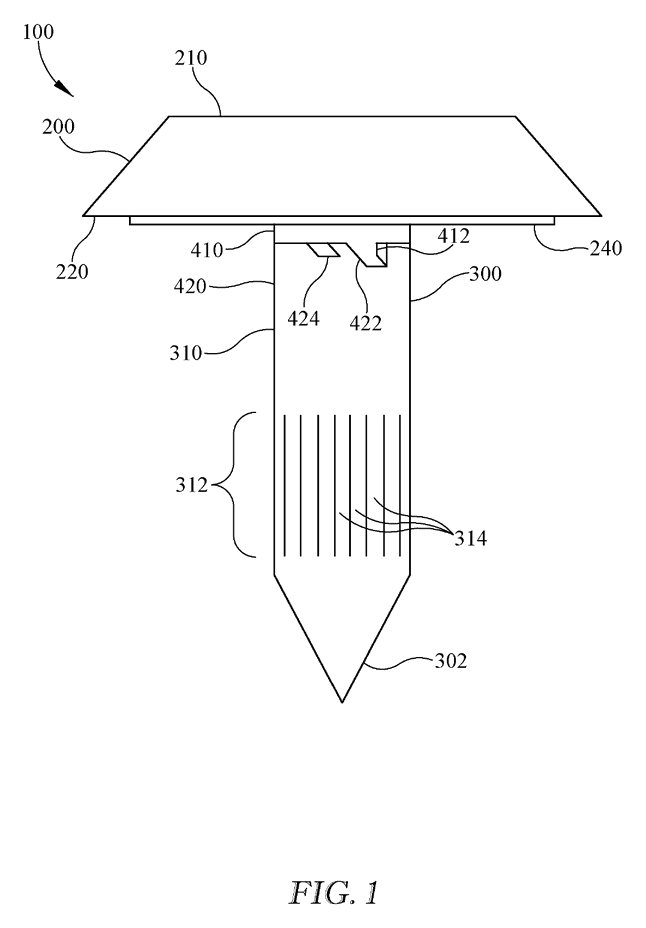
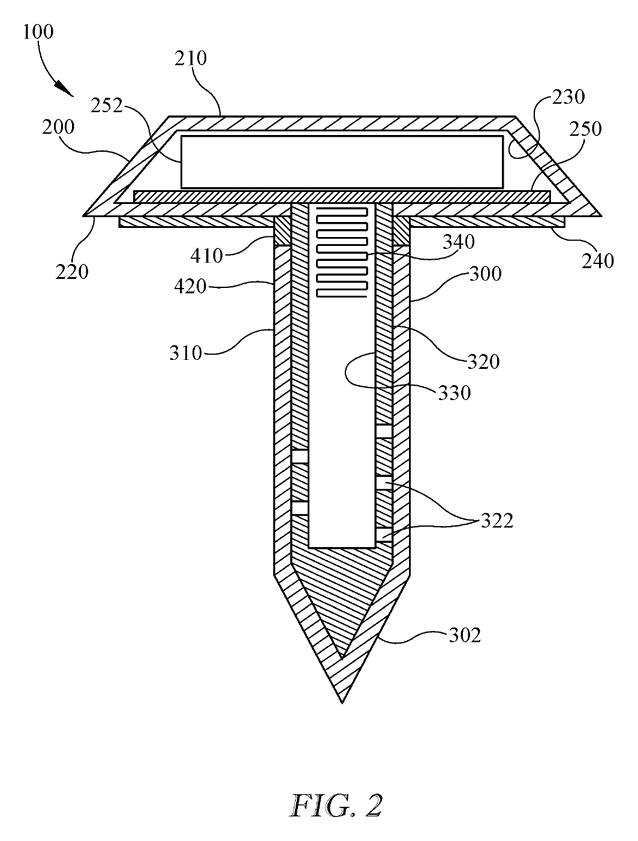
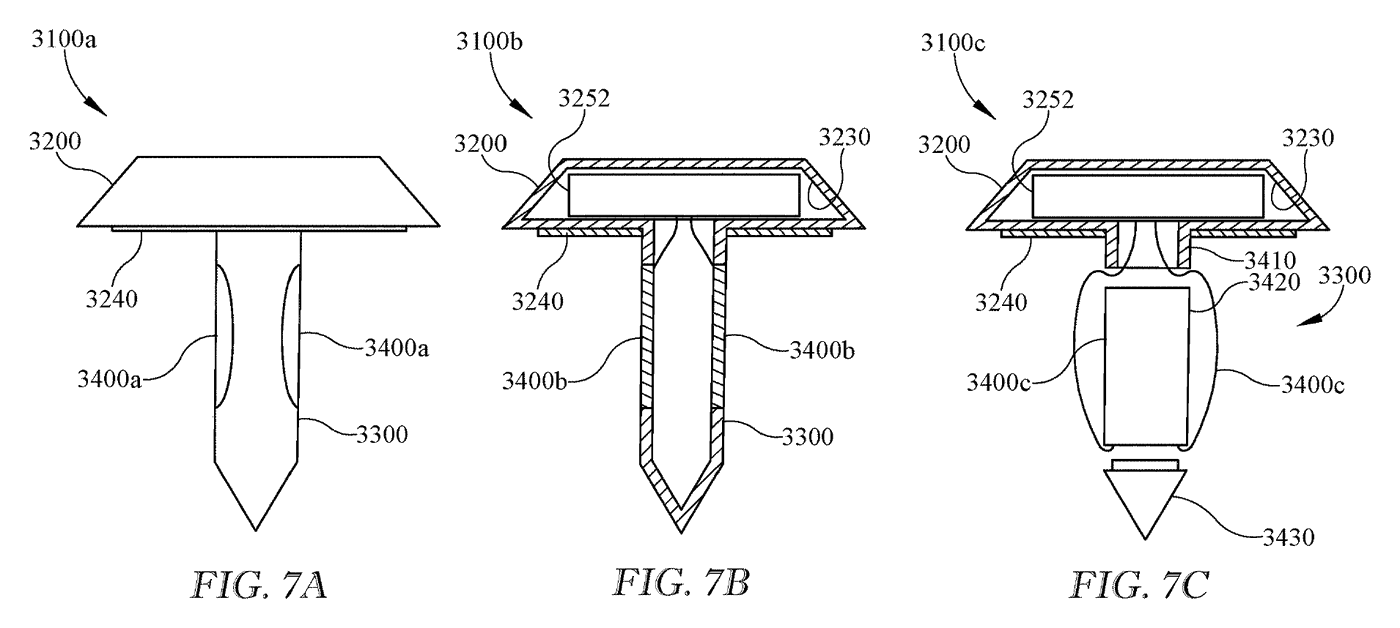
The application describes a spike-type freshness sensor: a cap that stays outside the package and a tapered spike that goes through the film and into the product. The cap houses the sensing element and the electronics, including an RFID or NFC chip for reading the result. A self-sealing adhesive layer on the underside of the cap bonds to the packaging and seals the puncture.
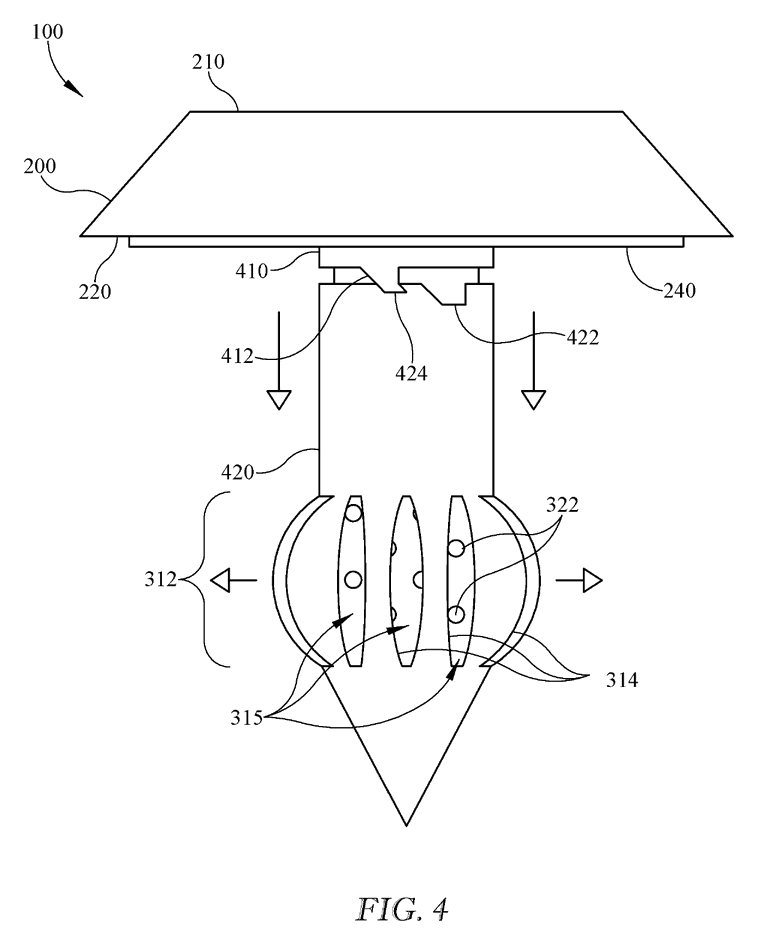
The key move is separating insertion from sampling. The spike goes in sealed. Only once it is in place does an expansion portion of its outer shell open, creating a small, controlled hollow in the meat and a gas path back to the sensor.
How it works
- The spike pierces the packaging film and enters the meat while its outer shell is fully closed.
- The adhesive layer on the cap bonds to the film and seals the hole, keeping the pack hygienic.
- A twist of the cap — or pulling a tab — drives the outer shell so its longitudinal members bulge outward.
- The bulge forms a small hollow in the meat and opens channels to perforations in the inner shell.
- Gas from the meat travels through the cavity to the sensing element, which tracks volatile nitrogen or biogenic amines.
- An RFID reader or phone reads the result at the plant, in the supply chain, in store or at home.
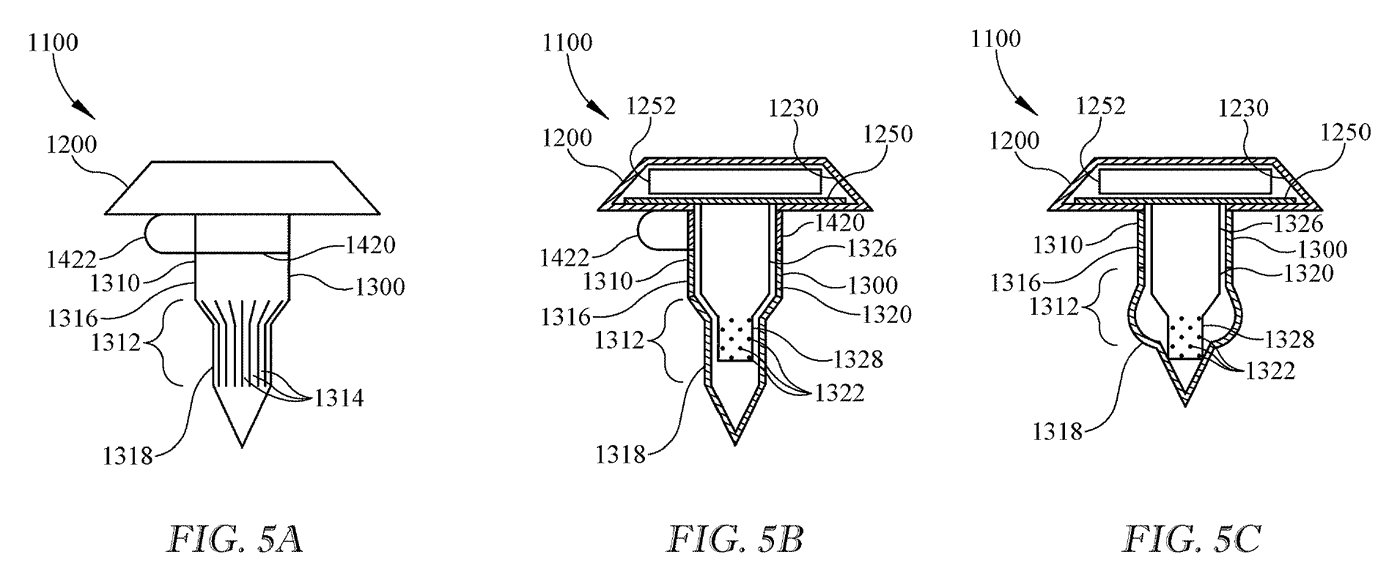
The application shows three ways to trigger the expansion: a rotating tooth-and-groove lock that pushes the lower shell like a piston, a removable collar that lets the shell slide up over a wider inner shell, and a contoured shell that separates the force needed to insert the spike from the force needed to open it, so it can't expand by accident.
Direct electrical sensing
The same spike and sealed-cap architecture also carries a second sensing mode. Instead of sampling gas, electrodes on the spike measure the bulk electrical properties of the meat itself, such as conductivity, as it decomposes. The electrodes connect to the electronics and RFID chip in the cap.
This mode drops the gas path entirely, which avoids many of the challenges of gas-based sensing. The application shows electrodes molded into the side of the spike and, alternatively, wires running along the outside of its middle section.
Gas mode
Expansion opens a hollow; the sensing element in the cap reads volatile nitrogen or biogenic amines from a known gas volume.
Electrical mode
Electrodes in contact with the meat track changes in its bulk electrical properties as spoilage progresses.
Why it matters
This design turns the freshness reading into a property of the individual pack. Instead of disposing of a whole pallet when one lot looks suspect, operators can sort out the packs that have actually turned and keep the rest on sale. Shoppers can scan a pack and see an estimate of how much time is left, instead of guessing around a printed date.
Sealed until it's in
Gas paths only open after insertion, so the spike doesn't shear the meat, and its smooth exterior is easy to keep clean.
A known sample volume
The sensor makes its own hollow, so every reading comes from a consistent pocket. That simplifies the freshness model and works even with no headspace.
No pack redesign
It goes onto existing meat packaging with little or no change to the pack design or the packing process.
What this shows
A good sensing chemistry is only half of a freshness product. The other half is mechanical: getting to the signal without damaging the thing you are measuring, and doing it in a form that fits existing packs and existing handling. This work is about that second half — designing the moment of insertion so the measurement can be trusted afterward.
It's the same thread that runs through my other work: move the measurement to where the decision actually gets made, and design the system around the real conditions it has to survive.
Co-inventors: Miriam Kolis and Anastacia Dwyer. Assigned to The Kroger Co.